About
This thesis researches abandoned architecture in relation to the conditions of human abandonment. Architecture is a living and breathing entity that requires attention. This research equates the abandoned structure with an abandoned human, focusing on the idea of a “prosthesis” and the “need to heal.” The thesis spans two parts: a theoretical research framework (Part I) and a practical design application to a specific abandoned structure in Beirut (Part II).
Full Thesis
A Non-Reconstructive Reclamation — Part I
Complete theoretical research document · 2017 · AUB B.Arch Thesis
↓ Download PDF
“…impossible, as impossible as to raise the dead, to restore anything that has ever been great or beautiful in Architecture.”
John Ruskin (1819–1900) & William Morris (1834–1896)
The ThesisTheory
This thesis researches abandoned architecture in relation to the conditions of human abandonment. Architecture is a living and breathing entity that requires attention — abandoned architecture is often neglected due to different circumstances.
The research equates the abandoned structure with an abandoned human. An existing abandoned structure possesses immense possibilities prior to its reconstruction. The process of intervening is framed not as reconstructive but as a reclamation — by understanding the different modes and techniques of intervention, we diagnose the abandoned architecture and identify the most suitable healing.
Concept 01
The Injured Man & the Abandoned Structure
The need for healing comes after something or someone has been neglected. A correlation between human healing and architectural healing — if architecture is treated as a living object requiring maintenance after abandonment, it is given a second chance for development rather than termination.
Concept 02
The Abandoned Diagnosis
The prosthetic becomes a form of healing applied to a neglected structure for development and enhancement. Degrees of abandonment lead to degrees of healing. Degrees of healing generate degrees of Prosthetic Intervention.
Concept 03
The Prosthesis
A prosthesis is defined (medically) as a device, either external or implanted, that substitutes for or supplements a missing or defective part of the body. Applied architecturally — each building suggests its own prosthesis. Integrate, not overshadow: contextually and functionally.
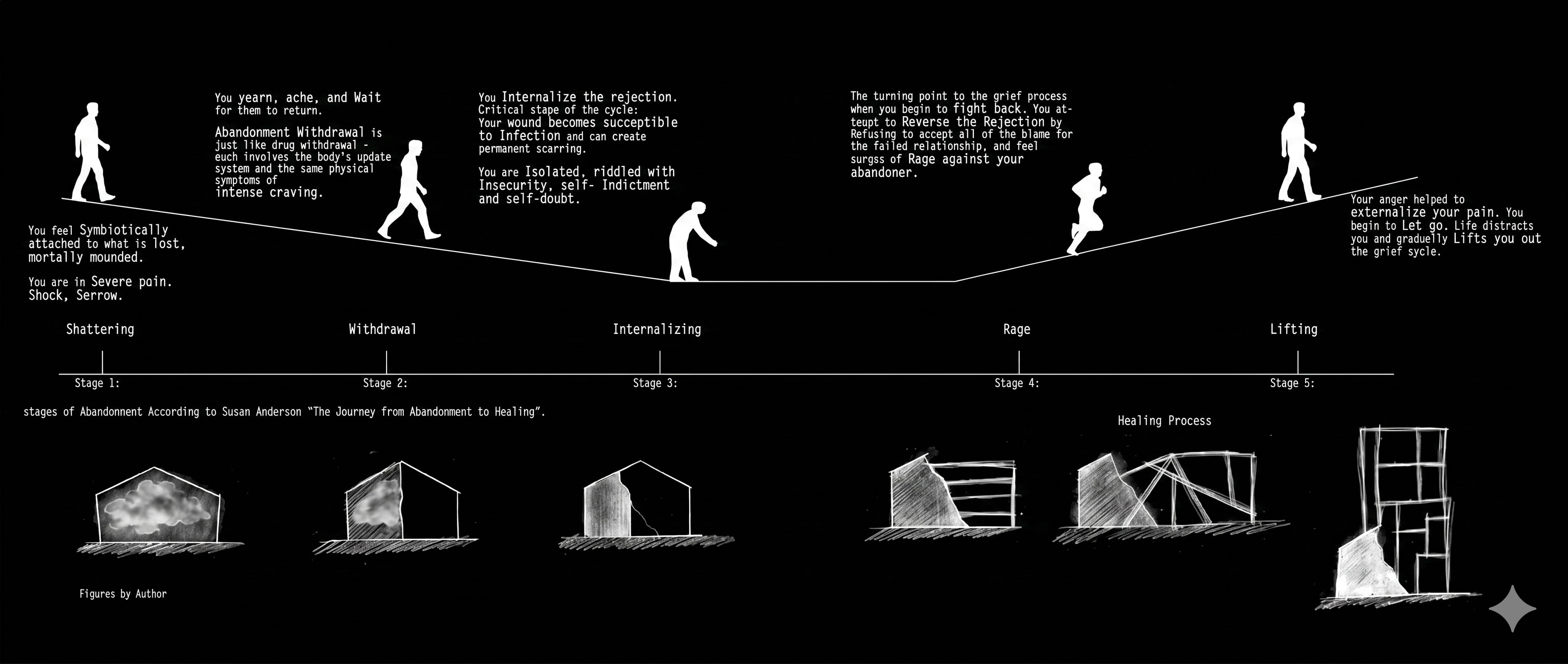
Stages of Abandonment — According to Susan Anderson
1
The Wounded
A mending prosthesis
A minimal intervention dealing with superficial injuries.
The Extroverted Prosthesis
Visible Addition — Exploitation · Maximum Space · Highlighting the Abandoned · Statement
2
The Amputee
A replacing prosthesis
Dealing with missing injuries.
The Introverted Prosthesis
Invisible Addition — Contextually aware · Conserving the exterior identity
3
The Dead
A total prosthesis
A total replacement dealing with a new space.
Integrate \ Not Overshadow
1. Contextually 2. Functionally — Each building suggests its own prosthesis.
Theories of
InterventionBollack, 2010
Bollack (2010) addresses in “Old Buildings New Forms: New Directions in Architectural Transformations” five existing modes of intervention on abandoned or historic buildings. Each mode implies a different relationship between old and new — from the most additive to the most embedded.
Weaving
Interlacing old and new
Parasite
Attached addition
Juxtaposition
Side by side contrast
Wrap
Surrounding the existing

The Prosthesis — Connection Types
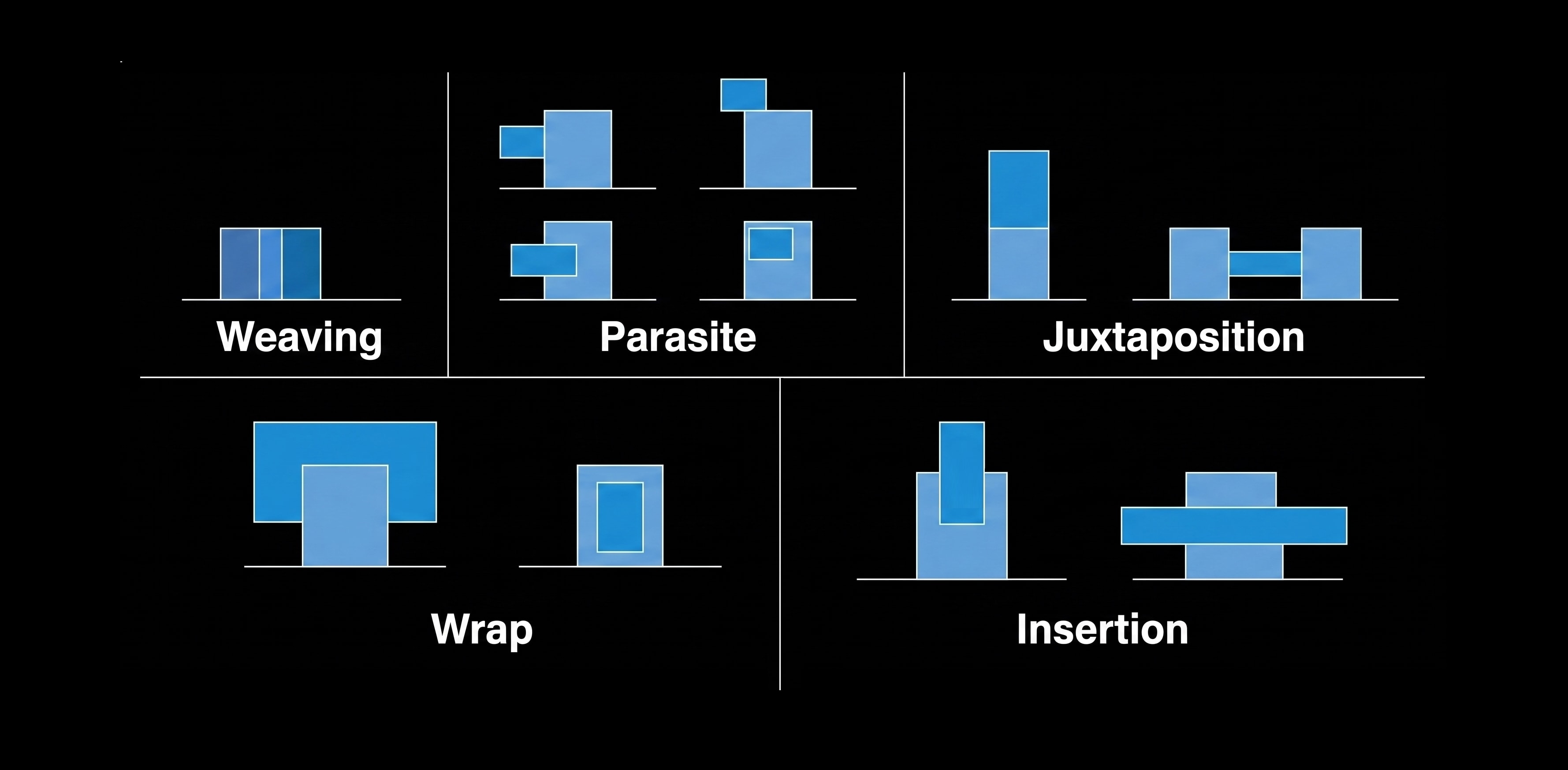
Theories of Intervention — Bollack
Tags
ResearchThesisAbandoned Architecture
ProsthesisTheoryHealingBeirut
Part II — Design
The focus of Part II is to reclaim the abandoned by understanding the material and identity of the structure while using technological advancement to cater for the rebirth and reclamation. The structure chosen is the Bechara el Khoury Mansion in Zokak el Blatt, Beirut — a highly neglected neighbourhood once home to artists, painters, and musicians.
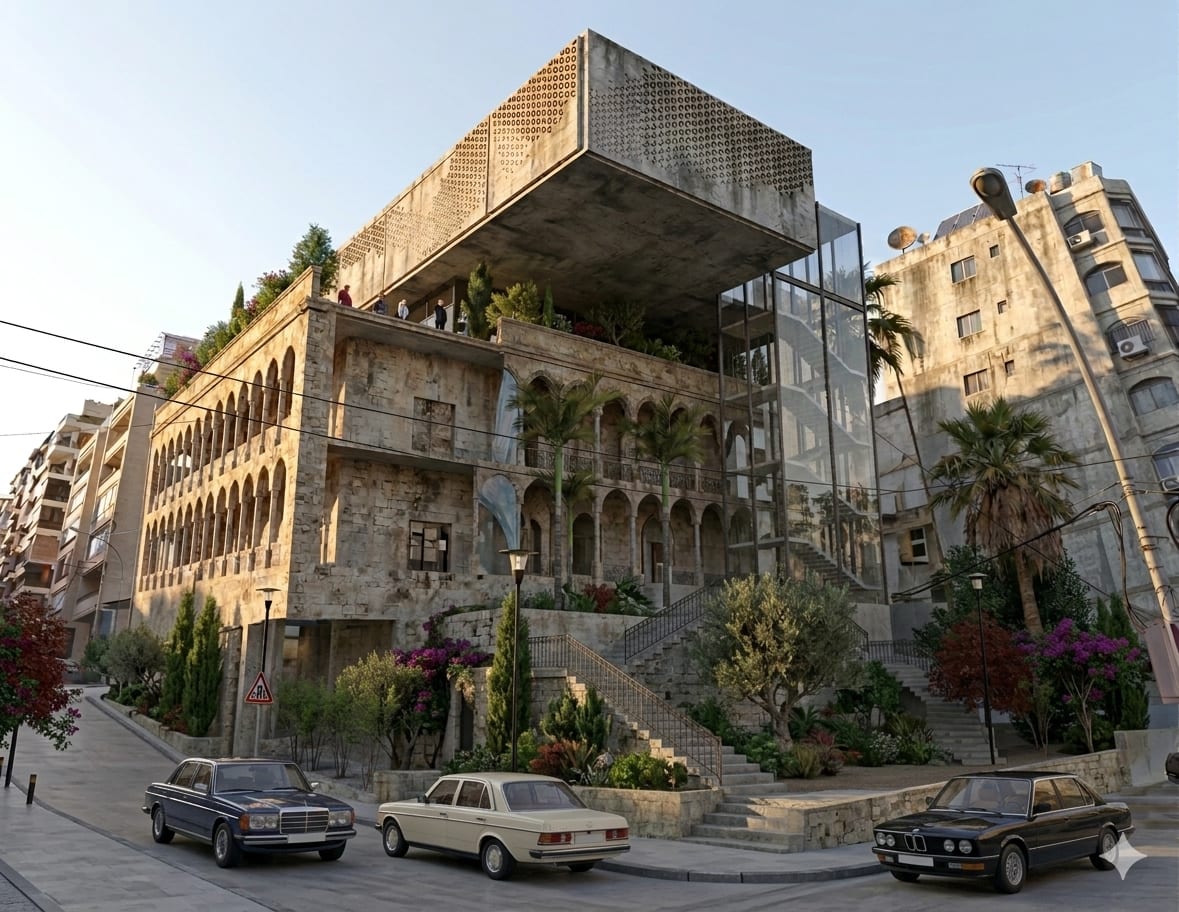
Bechara el Khoury Mansion — Zokak el Blatt, Beirut
The SiteBechara el Khoury
Mansion
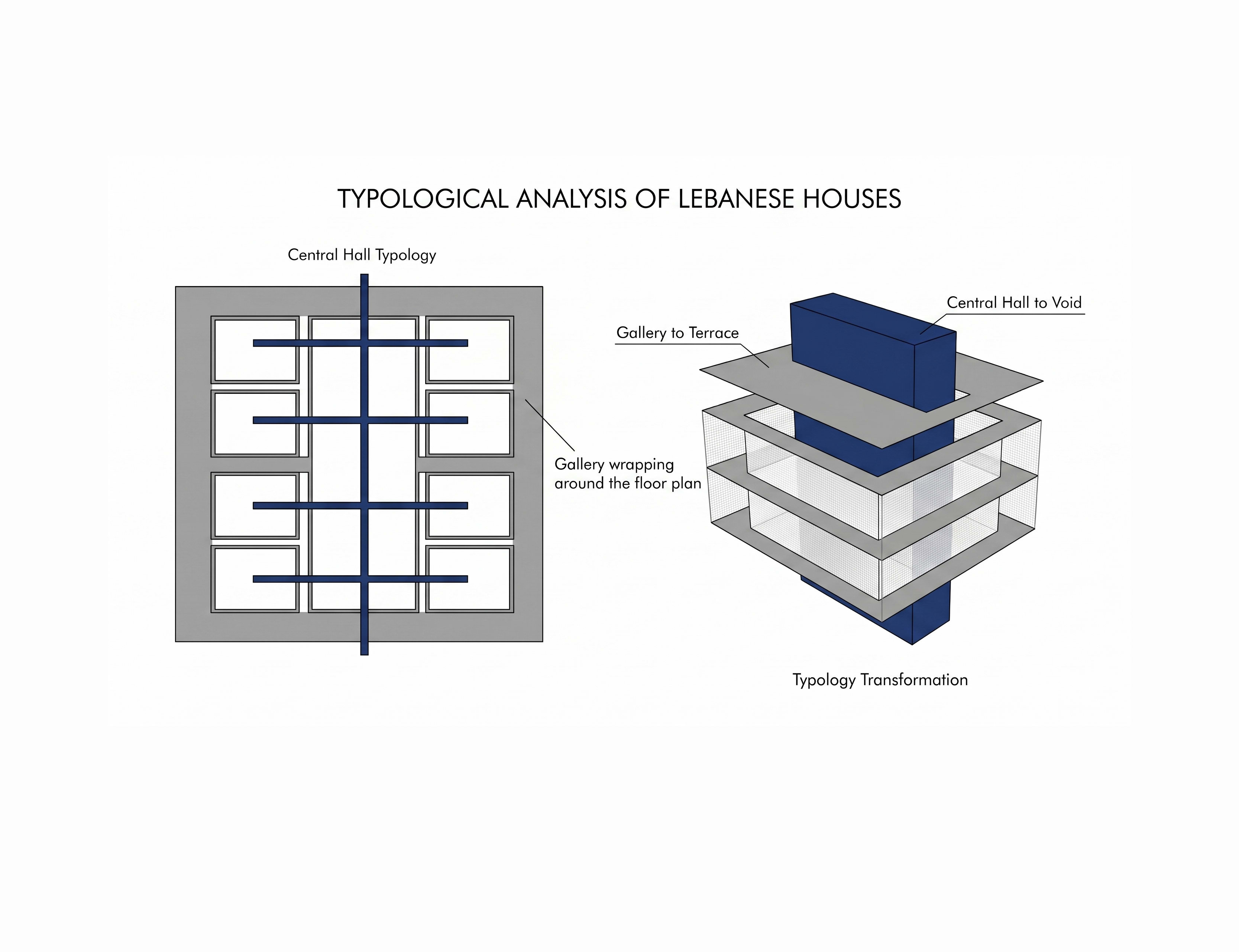
The mansion is made up of 2 floors. You enter the site with a large symmetrical staircase that leads up to a front yard, then another staircase to the ground floor. The Central Hall typology and the Gallery wrapping describe the traditional Lebanese house typology.
For this intervention, the central hall was transformed into a vertical void spanning the entire 4-storey mansion. The Gallery was replicated along the entire mansion, acting as a terrace and outdoor space. The building becomes a Cultural Centre — reclaiming what was once unevident to the neighbourhood.
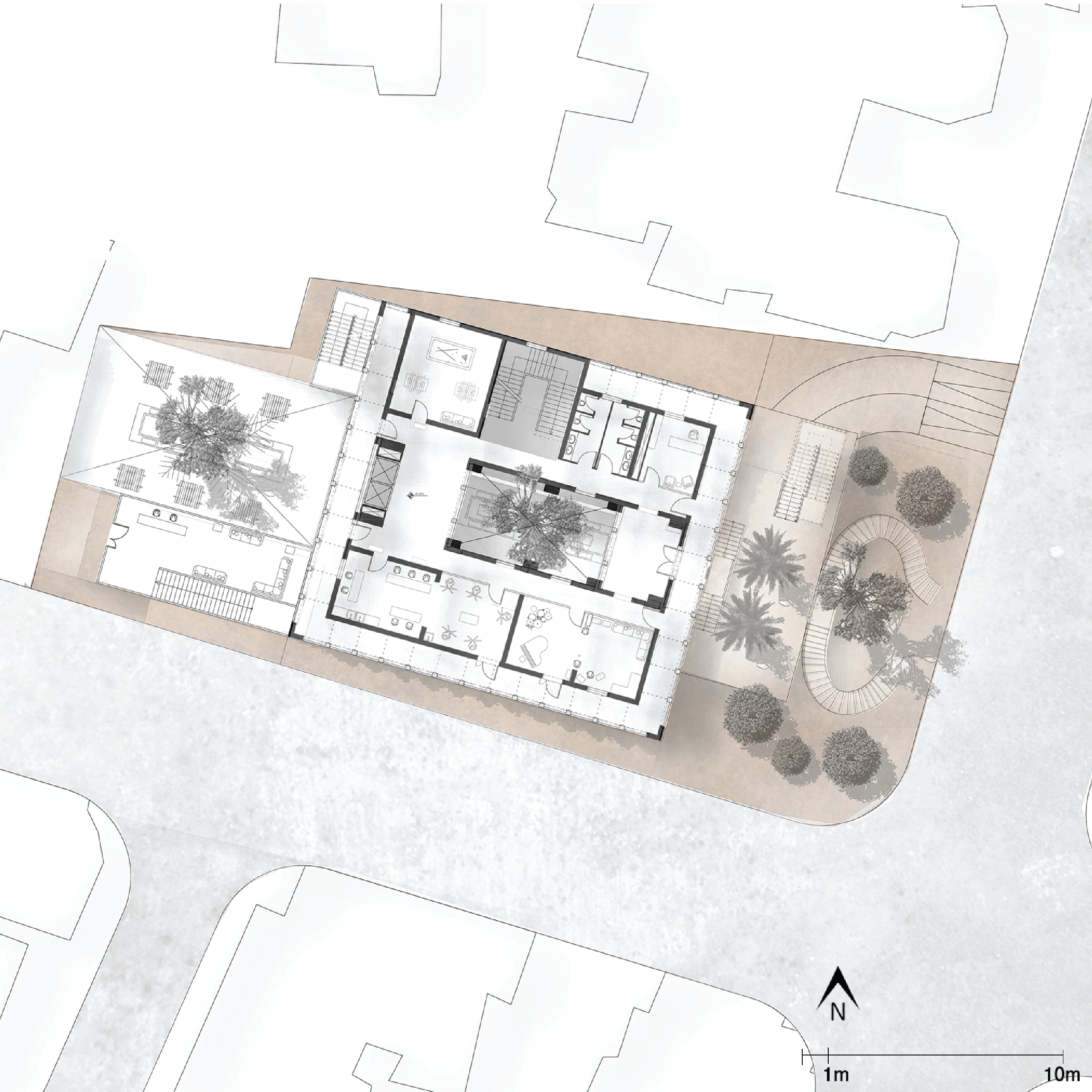
Ground Floor Plan
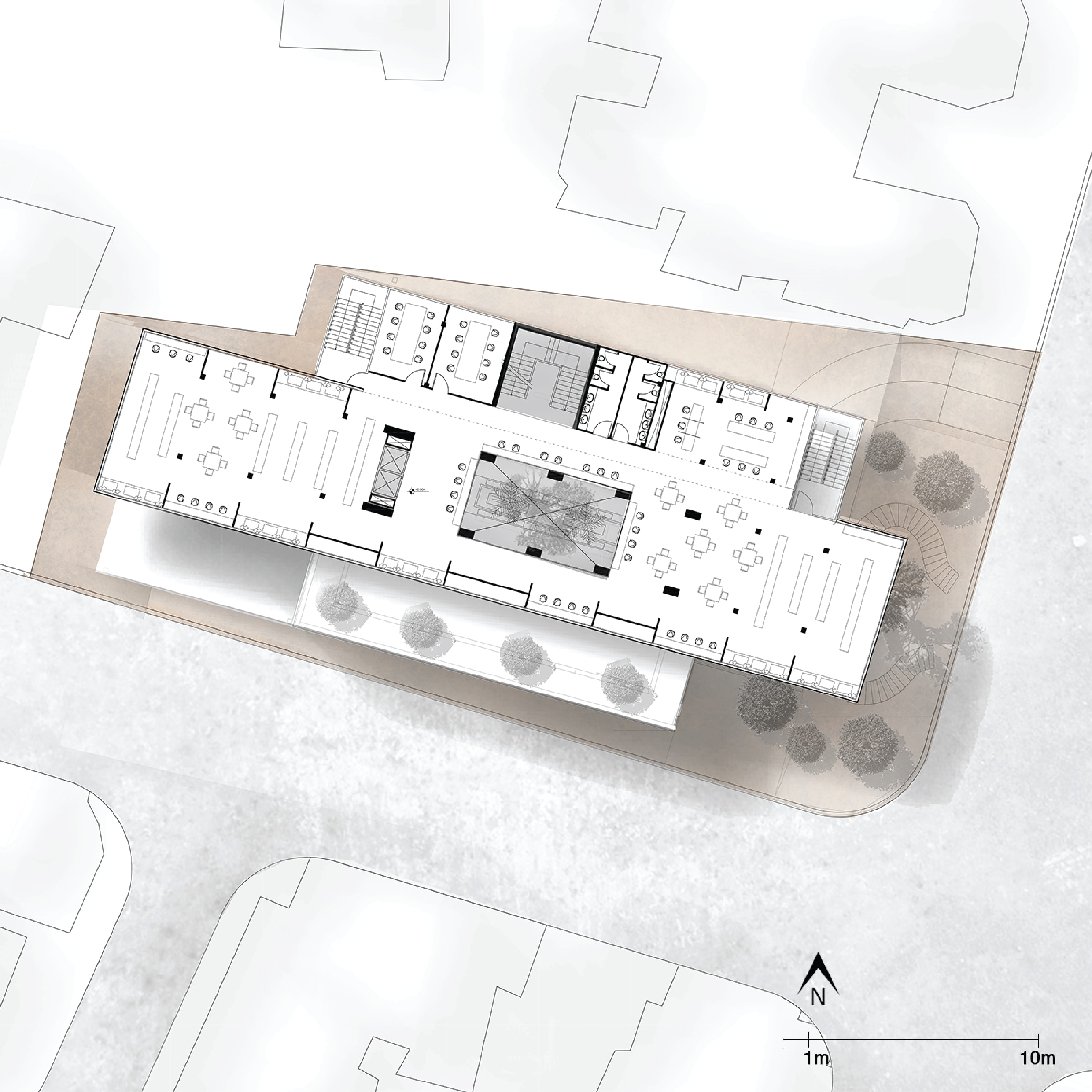
Top Floor Plan
Typology
TransformationLebanese house type
The Central Hall to Void — the traditional hall is opened vertically across all 4 floors, becoming an atrium of light and circulation. The Gallery to Terrace — the wrapping gallery is extended and becomes an outdoor terrace at every level, connecting the building to the city.

Central Void — Cultural Centre Interior
Methods of
InterventionProsthetic applied
Two primary methods are applied: juxtaposing behind the structure a connecting new prosthesis, and superimposing a new structure onto the existing. These follow both rural and urban concepts of expansion — tested through massing studies before being developed into the final scheme.
Methods of Intervention — Diagrams
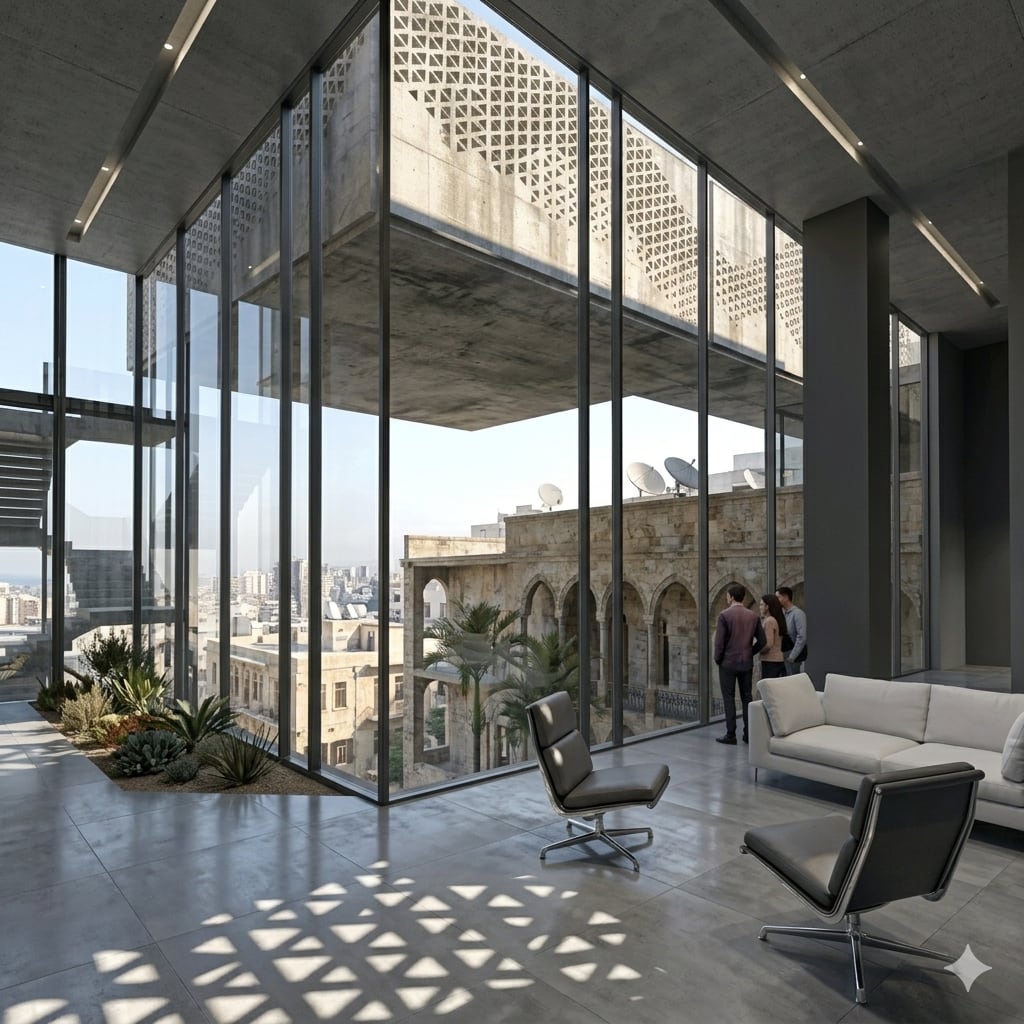
Interior
Structural
SystemNew addition
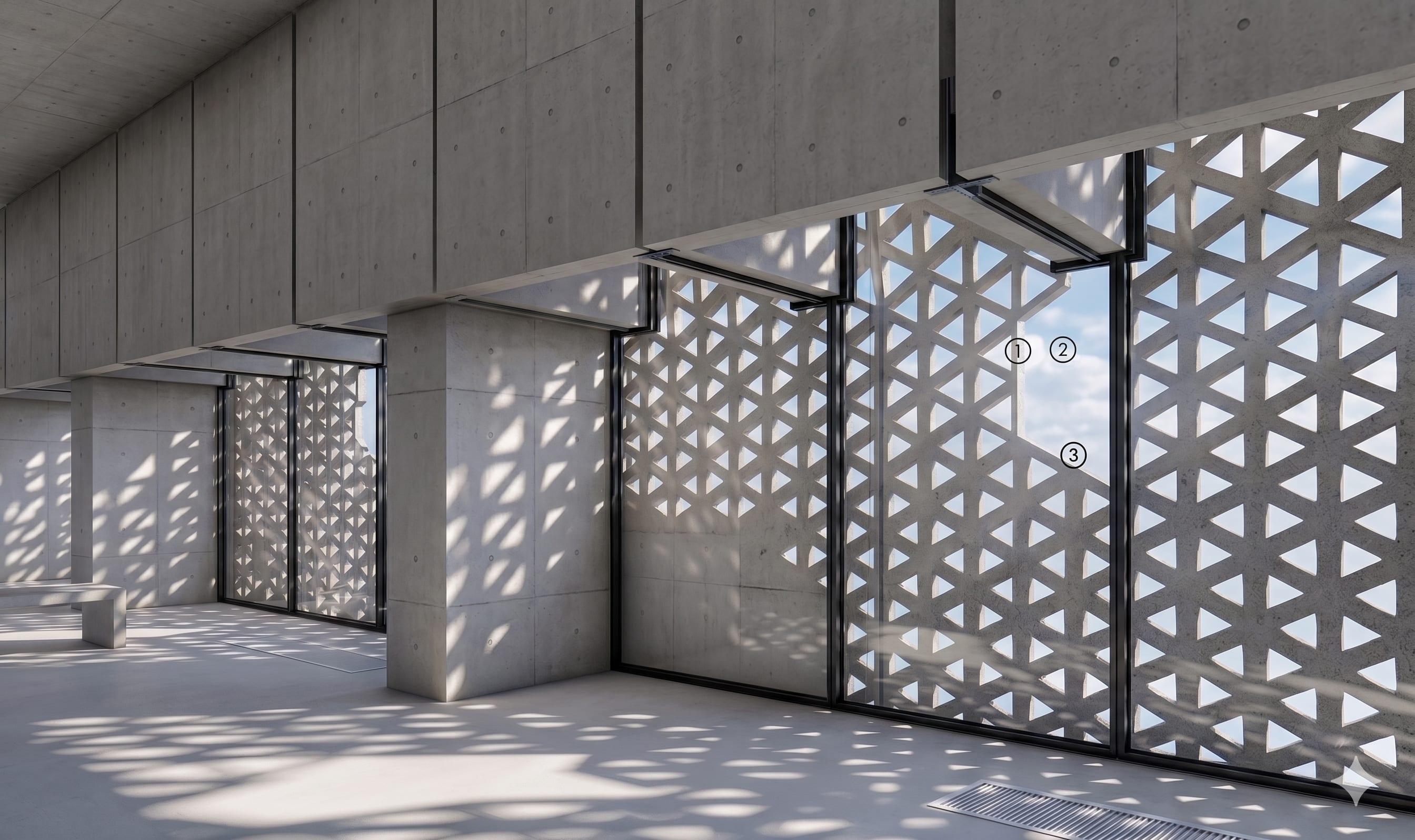
The new addition follows a structural language that contrasts the existing stone building. A deep crimson steel truss roof system spans the new floor, supported by gold-ochre concrete columns and frosted cyan structural cores. The facade of the addition uses a curtain wall system with an external skin of triangular perforations derived from sun orientation and wind direction.
Crimson Steel Truss Roof
Deep crimson steel truss · composite steel slab
Gold-Ochre Columns
Precast · rebar reinforced concrete
Frosted Cyan Cores
Concrete & translucent glass · structural
Triangular Facade
Curtain wall · perforated aluminium screen
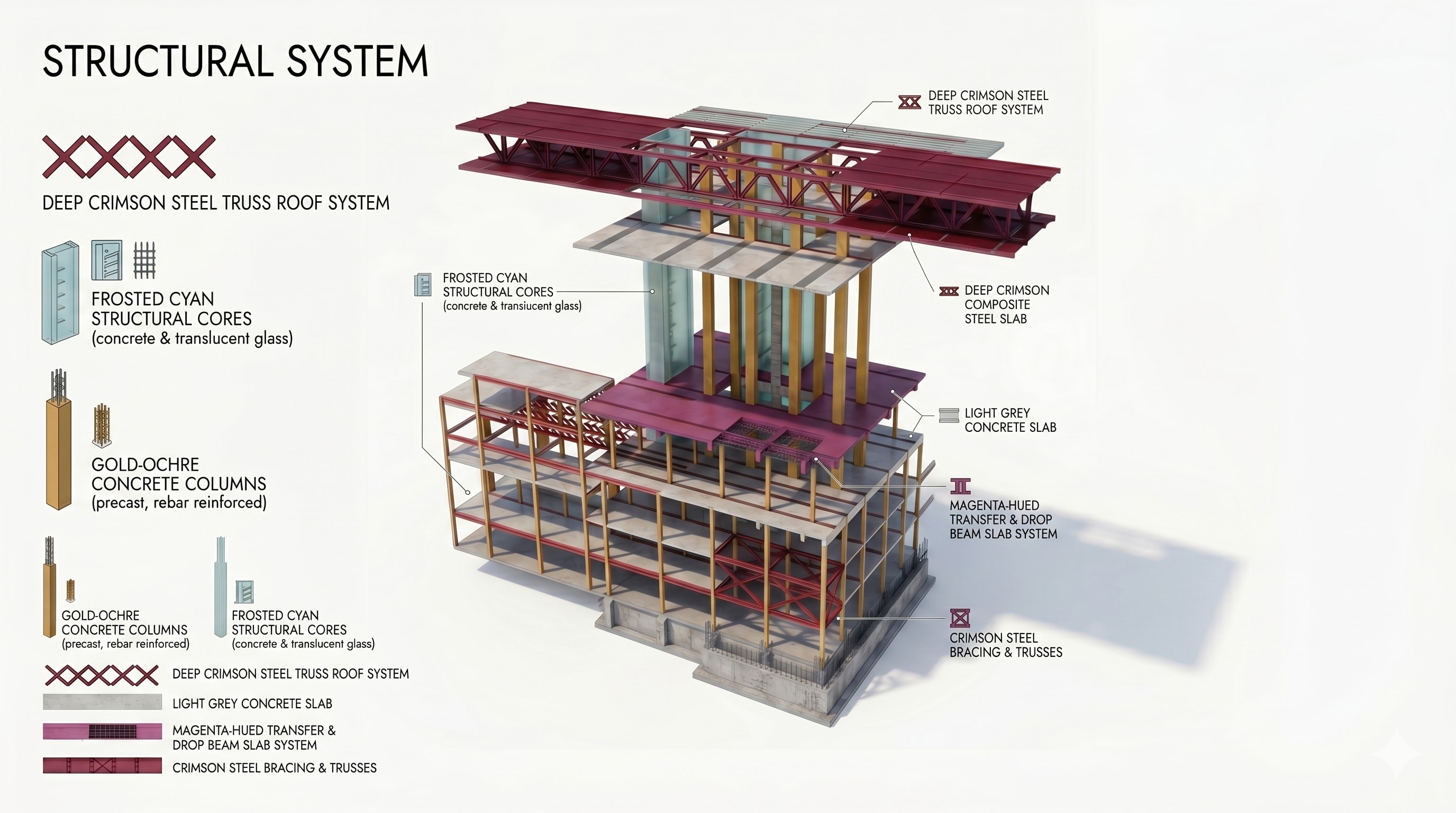
Structural System — Axonometric
Triangular Perforated Facade — Interior
Facade
SystemSun + wind driven
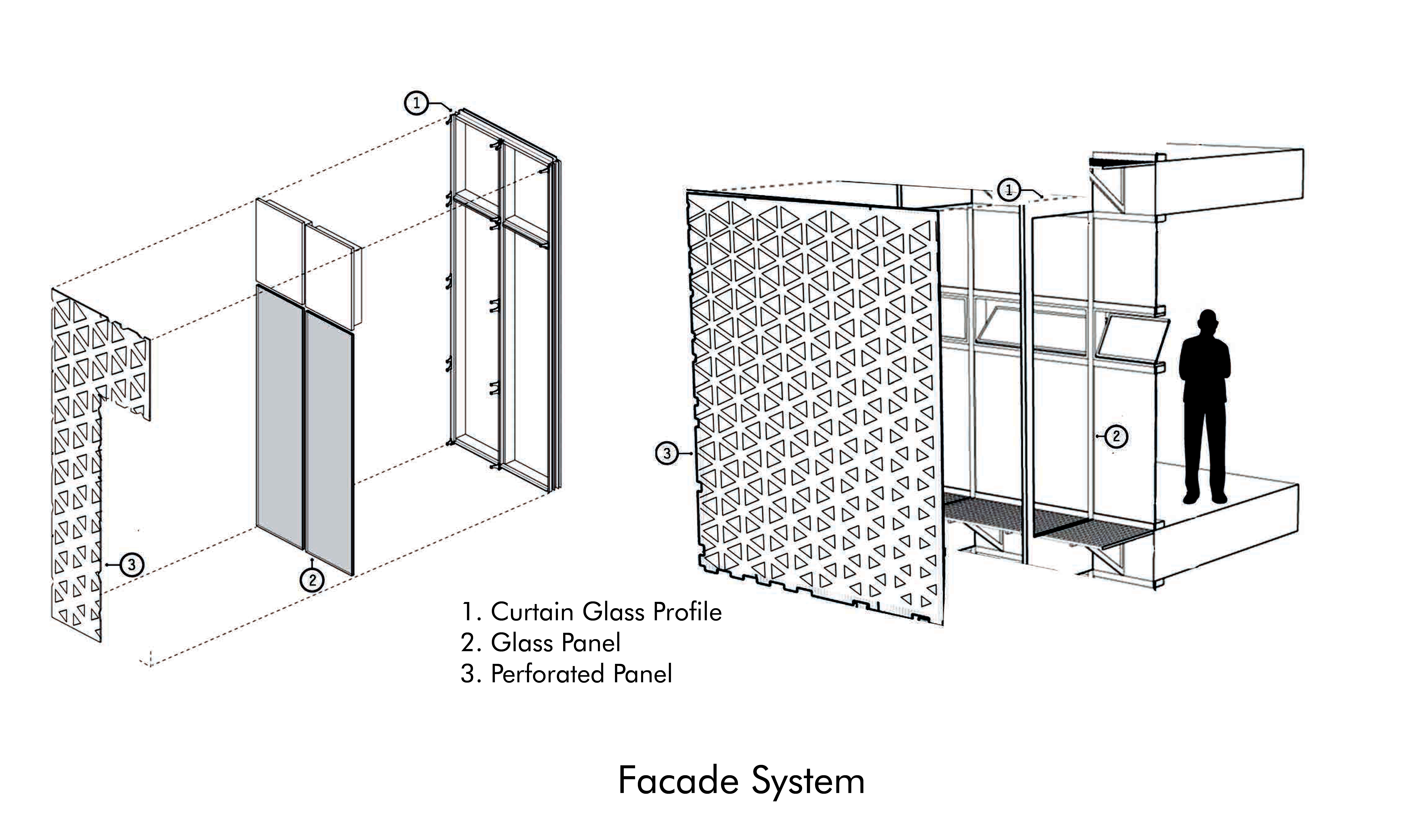
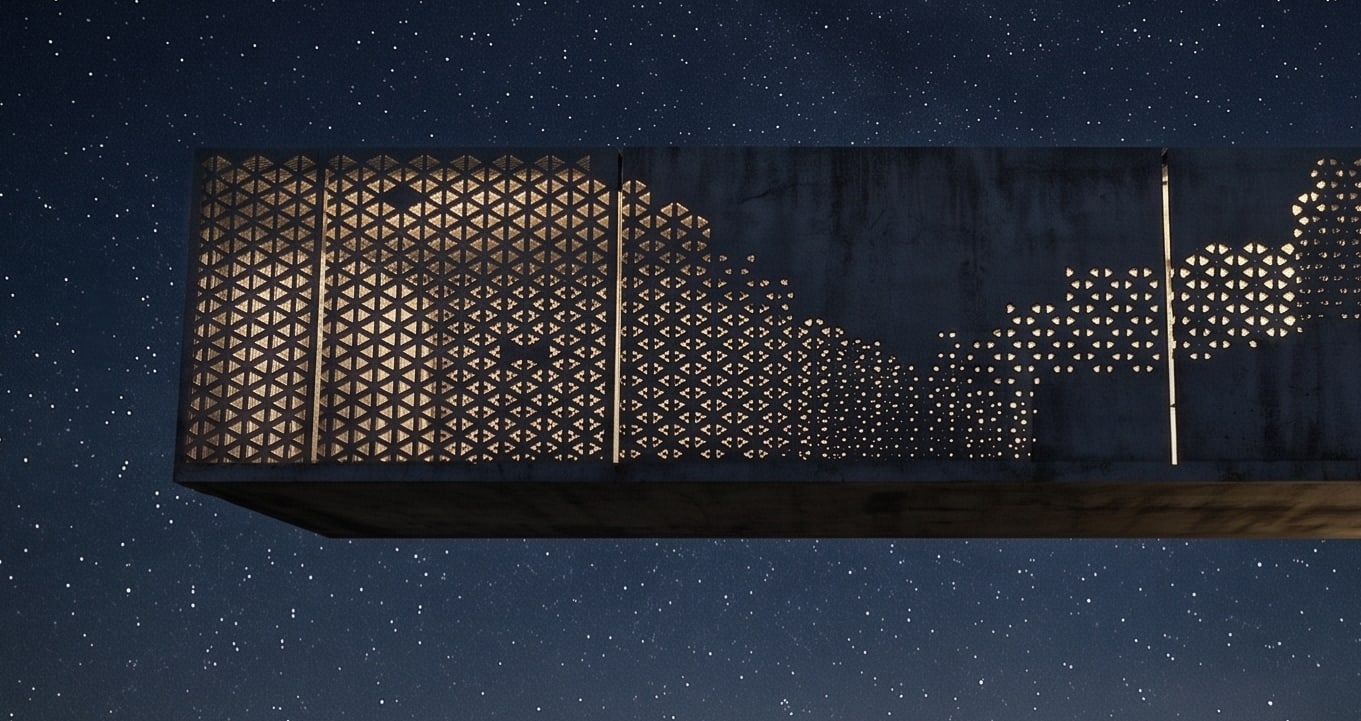
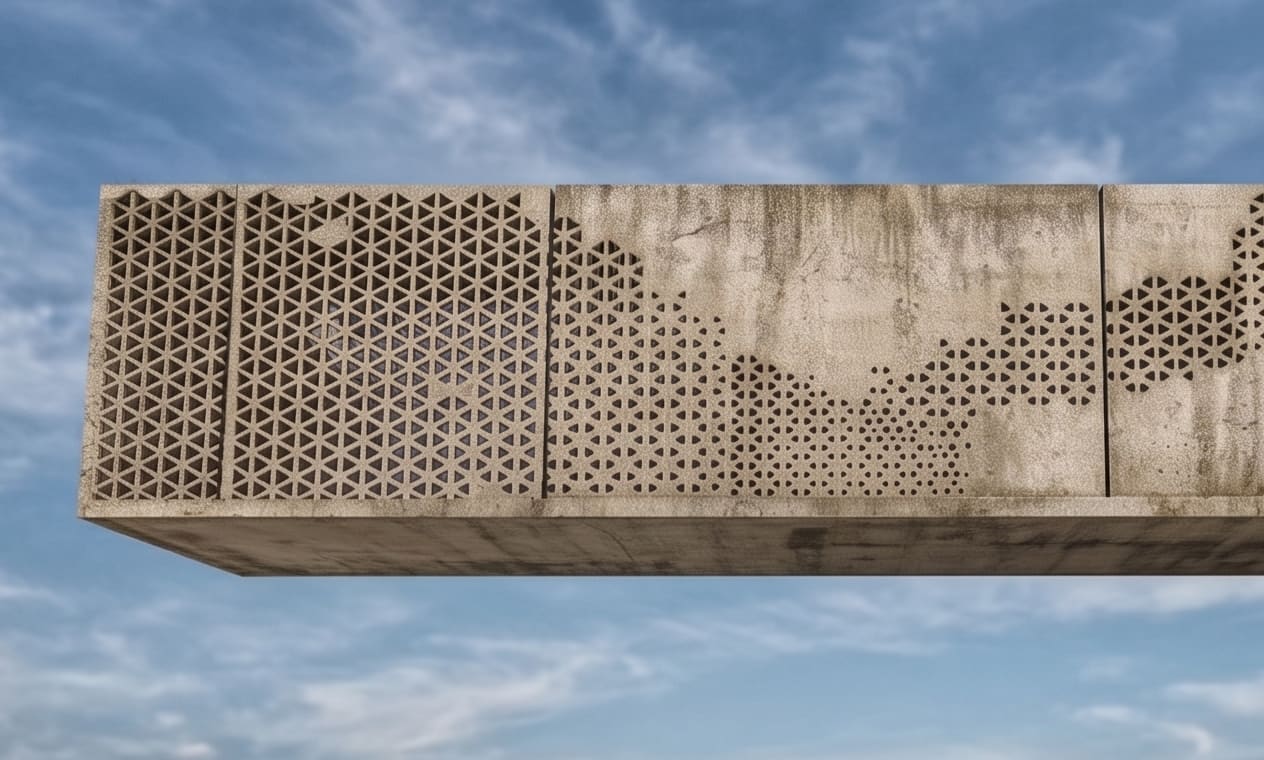
Based on the sun orientation and wind direction, triangular perforations are derived along the entire facade of the additional floor. The facade follows a curtain wall system — after the glass panels are installed onto the CW profile, an external skin of triangular perforations is mounted onto the aluminium profile, acting as a shading and wind device.
Three layers: 1. Curtain Glass Profile 2. Glass Panel 3. Perforated Panel.
Facade System — Layers
Perforated Panel — Night
Perforated Panel — Day
Tags
Design ThesisCultural CentreAdaptive Reuse
BeirutHeritageFacade SystemCurtain Wall
